BRYCE ON HISTORY
– How technology changed the country and the world.
(Click for AUDIO VERSION)
To use this segment in a Radio broadcast or Podcast, send TIM a request.
 If you were to ask young people what they consider the most influential inventions that affected America, they would likely respond with the PC, Apple’s iPhone and iPad, or perhaps the new Google Glasses. This reflects the erosion of our sense of history. I would argue even though these inventions are interesting, their development was inevitable and the natural byproduct of earlier inventions. Understanding America requires more than just the memorization of important dates, such as 1776, but also the inventions we created along the way. Our inventions ultimately dictate who we are, for they were devised to solve particular problems and to remain competitive in the world community. They also reflect our resourcefulness and determination to get things done by rising above the status quo.
For historical purposes, I have assembled the following list of arguably the greatest American inventions. These ideas and devices not only impacted our country but the world at large. In addition to enhancing productivity and business, they also influenced our society.
There are far too many significant inventions to list here. Instead I was interested in identifying those which had a profound effect not just on business, but socially as well. For example, Franklin’s lightning rod was useful for curbing lightning strikes and ensuing fires, but it did not affect the social conscious of the nation. Eli Whitney’s cotton gin greatly enhanced the output of cotton in the South, but it also encouraged a dependency on slavery and contributed to the outbreak of the American Civil War. There were many others, but I wish to point out those which positively influenced the American character.
Steam Engine (1781) – True, the first steam engines were introduced in Spain and England in the 17th century, but it was James Watt’s engine that provided the first practical implementation which would be used in railroads, ships, and other manufacturing and agricultural applications thereby becoming an important cog in the Industrial Revolution. In addition to improving output, the steam engine improved transportation, thereby making us a more mobile society by connecting the country. Train service also improved communications by expediting mail service. These effects would later be emulated by the introduction of the internal combustion engine.
Morse Code (1836) – The electric telegraph was another invention derived from Europe and preceded by the optical telegraph (signalling). The first practical implementation though came in 1844 with the first long-range telegraph between Baltimore and Washington, DC where inventor Samuel F.B. Morse sent the famous expression, “What hath God wrought,” a phrase from the Bible’s Book of Numbers. This was all made possible through the use of Morse Code, a standard system of dots and dashes which transmitted text messages. In reality, Morse Code was invented by Morse, American physicist Joseph Henry, and machinist Alfred Vail. This system revolutionized communications. Messages and news could be easily disseminated in seconds as opposed to days. This kept the public informed of current events and allowed business decisions to be made more readily. The Trans-Atlantic Cable bridged North America with Europe, thanks to Morse’s standard language. The telegraph may be long gone, but Morse Code lives on through Ham Radio operators. Remarkably, the system is still faster than newer techniques, such as text messaging.
Baseball (1845) – although historians argue over the origin of the game, baseball’s roots were likely derived from “rounders” in England. Nevertheless, the rules and game of baseball are uniquely American. The beauty of it is just about anyone can play it, assuming you can run, catch, throw, and swing a bat. It is also a thinking game with subtle strategy and secret communications, thereby making it an ideal spectator sport. Unlike other games played on a rectangle and scoring by taking a ball or puck to an end zone or net, baseball is played on a “diamond” which is actually a field defined by a 90 degree angle. To the outsider who has never played the game, baseball seems confusing at first, but with a little patience, the quirks of the game can be quickly learned. Because of its popularity, baseball has been dubbed America’s “National Pastime,” and a welcome diversion from the tedium of life. Aside from the United States, it has become popular in Central and South Americas, Japan, China, Australia, Europe, and elsewhere.
Telephone (1876) – Alexander Graham Bell was awarded the first patent for the electric telephone in 1876. As with other technologies listed here, others were active in its development, but Bell was first. The telephone revolutionized communications not only in America but throughout the world. Whereas phones were originally placed in a key location in a town, it propagated to households and businesses, and eventually to just about every individual on the planet. A boon to communications, the telephone also affected the populace socially. For example, the phone has been an indispensable tool for teenagers for many years and was likely the driving force for developing the “smart phones” of today.
Phonograph (1877) – Thomas Edison’s “talking machine” provided a handy tool to entertain people who were not proficient in the use of a musical instrument. Interestingly, the cylinders of Edison’s machine ultimately became the hard drives of today’s computers and smart phones, all based on circular devices for storing and retrieving data.
Radio (1885) – Again, experiments were conducted earlier, but it was Edison who received the first radio patent. For a long time, radio was the principal means of communicating with the public. It revolutionized news reporting and entertained the public. More importantly, it introduced the technology which would ultimately be used for television, radar, and today’s cell phone towers.
Tabulating Machine (1890) – Herman Hollerith is credited with inventing the tabulator using punched cards. This was fostered by the 1890 census which was desperately in need of a better approach for counting. Hollerith’s invention not only proved useful for the US Bureau of the Census, but for business in general. It was the precursor of the modern day computer and was eventually used for accounting, inventory, and just about anything requiring counting. The machine also gave birth to a new company which would influence technology and business for years to come, IBM. Tabulating machines were used until the 1950’s when the computer finally replaced them.
Electric Power Distribution (1882) – although Edison did not create the light bulb, he invented the first power grid in New York City to use his electric lamps, thereby turning the darkness of night into light (Pearl Street in Manhattan). The effect was dazzling and changed our social life at night. Candle power was no match for Edison’s electric grid, something that is with us to this day.
Assembly Line (1901) – the concept of routine assembly using standard parts has been around for centuries, but it took Henry Ford to mechanize it to produce his line of automobiles, thereby revolutionizing the process of manufacturing. This is one of the most important concepts to emerge from the Industrial Revolution. It’s been used to produce everything from automobiles and airplanes to a multitude of electronic devices and just about every consumer related product imaginable, including the smart phone. By doing so, the assembly line made it possible to make products affordable for just about everyone, thereby creating a middle class.
Air Conditioning (1902) – Willis Carrier was the inventor of “electromechanical cooling” which was originally intended for companies with products requiring climate control, such as printing, photography, and chemicals. This technology was eventually used for general business comfort, as well as in automobiles and homes. The air conditioner had particularly affected the South where temperatures during the summer would prohibit work and sleep. The advent of the air conditioner was a major contributor to people migrating to the South, including yours truly.
Airplane (1903) – The Wright Brothers are credited for “the first sustained and controlled heavier-than-air powered flight.” Like the Steam Engine, it had a profound effect on transportation and communications, although it devastated passenger rail service. By conquering the sky, we made the world a smaller place to live, accessible to just about anyone. It has helped forge business relationships overseas, thereby improving commerce, and made America more aware of the world around us.
Credit Card (1950) – the credit card traces its roots back to air travel cards which would allow you to “buy now, pay later.” The Diners Card became the first charge card, which was quickly followed by Carte Blanche and American Express in the 1950’s. BankAmericard, which would evolve into Visa, would follow, as would Master Card, and Discover Card much later. Prior to this, the concept of paying for merchandise with anything other than cash was unimaginable. Today it is just the opposite as most transactions are recorded by credit cards. Its only drawback is that it is probably the single most significant cause for people to go into debt by over spending.
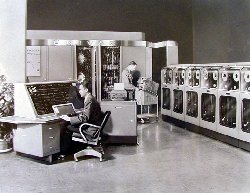
Computer (1951) – I realize people will argue the ENIAC was the first computer as commissioned by the US Army in the closing days of World War II, but it was the UNIVAC I (UNIVersal Automatic Computer) which became the first computer to be used for commercial purposes. Both machines were invented by J. Presper Eckert and John Mauchly, two pioneers who exhibited great foresight into the world of computing for many years. The product they produced set the stage for super computing and mini computing, ultimately leading to the smart phone, the PC, and the Mac. Without the likes of Eckert and Mauchly, there would not have been a Bill Gates or Steve Jobs. The computer has touched our lives like no other machine before or since. It is probably impossible to think of an industry or person who remains unaffected by the computer.
Internet (1969) – This was developed as a project for the Department of Defense to communicate with universities and research institutions. Today, it is the lifeline we all use for e-mail and to traverse the world wide web. It is also used to purchase merchandise, send/receive phone calls, transmit live photographic images, secure our homes, search for a mate, social networking, and more. And, No, Al Gore most definitely did not invent the Internet (he was 21 at the time and still in school).
U.S. Constitution (adopted 1787, ratified 1789) – This is perhaps the most brilliant invention in our history. Some would argue it is not unique. True, many of the concepts were derived from earlier political philosophers (e.g., Sir Edward Coke, William Blackstone and France’s Montesquieu, not to mention the Magna Carta), but the Constitution was the first practical implementation of such ideas. Fortunately, the authors of the Constitution were well versed in history and political philosophy, including the ancient Greeks and Roman empire. What makes the Constitution unique is its three separate but equal branches of government, its checks and balances, its bicameral system of Congress (two chambers), to act as a Republic as opposed to pure Democracy, and the Bill of Rights which enumerates the rights of American citizens. They were also wise enough to make it modifiable, so revisions could be added.
James Madison was the principal author of the Constitution and would later serve as our country’s fourth president. Madison and his Virginia colleagues came to the Constitutional Convention prepared and introduced the “Virginia Plan” which served as a template for the Constitution.
The Constitution superseded the Articles of Confederation and Perpetual Union which was our first governing document produced shortly after the Declaration of Independence. Whereas the Articles of Confederation simply stipulated how the various states would work together, the Constitution was to be more definitive in terms of devising a federal government. It took two years for the Constitution to be ratified by the thirteen states, a miracle in itself. The “Federalist Papers” were written and distributed to explain the rationale for the various parts of the Constitution, thereby selling the idea to the country.
The fact the U.S. Constitution has stood the test of time (225 years) and survived a bloody Civil War is a testament to its merit. It has also been emulated by states in the union and other countries, including Mexico and the Philippines. So brilliant is the document, I cannot imagine today’s Congressmen as being able to devise anything remotely better. As an aside, it is the Constitution which includes the provision for protecting intellectual property such as the inventions listed here (Article One, Section 8). Without such protection, our volume of inventions would be much less.
All of these devices have had a deep-seated effect on the American character. It defines who we are, what our values are, how we conduct business, and how we socialize as a people. We must recognize for every new invention we can expect some sort of social adjustment or change in our perspective or thinking and, with rare exception, there will likely be legislation enacted to control and tax its use.
Make no mistake, we have been influenced by our technology since the founding of this country, and way before. As such, it is important to remember when these inventions were created, the people who invented them, but more importantly the rationale for their creation. Without a sense of history, we would likely not understand the direction of where our technology and world should be heading.
Keep the Faith!
Note: All trademarks both marked and unmarked belong to their respective companies.
 Tim Bryce is a writer and the Managing Director of M&JB Investment Company (M&JB) of Palm Harbor, Florida and has over 30 years of experience in the management consulting field. He can be reached at timb001@phmainstreet.com
For Tim’s columns, see:
timbryce.com
Like the article? TELL A FRIEND.
Copyright © 2014 by Tim Bryce. All rights reserved.
Listen to Tim on WJTN-AM (News Talk 1240) “The Town Square” with host John Siggins (Mon, Wed, Fri, 12:30-3:00pm Eastern), and KIT-AM 1280 in Yakima, Washington “The Morning News” with hosts Dave Ettl & Lance Tormey (weekdays. 6:00-9:00am Pacific). Or tune-in to Tim’s channel on YouTube.