BRYCE ON MUSIC
– It is interesting what we remember.
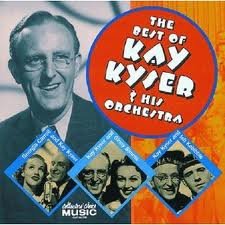 Ever drive along in a car and suddenly an old tune comes to your lips, perhaps something from your childhood? Recently, I found myself blurting out, “Boop boop dit-tem dat-tem what-tem Chu!” Frankly, I couldn’t remember the name of the song, which I found rather irritating. This caused me to look it up through an Internet search engine. Remarkably, it was:
“Three Little Fishes” (click for Lyrics)
This was introduced by Kay Kysor and featured Ish Kabibble. The words and music were by Saxie Dowell and the song was a US No. 1 hit in 1939. Here’s a sample of the lyrics:
Down in the meadow in a little bitty pool
Swam three little fishies and a mama fishie too
“Swim” said the mama fishie, “Swim if you can”
And they swam and they swam all over the dam
Boop boop dit-tem dat-tem what-tem Chu!
Boop boop dit-tem dat-tem what-tem Chu!
Boop boop dit-tem dat-tem what-tem Chu!
And they swam and they swam all over the dam
I cannot explain why I recollect this song as it certainly wasn’t from my generation. Perhaps I remember it as a song from childhood. Whatever the reason, I found it remarkable I could recall it. Actually, there are a lot of old-time songs cluttering our minds. They’re not particularly complicated, in fact they are rather simple with a catchy tune. We may not remember all of the words for these nonsense songs, as I call them, but we readily recognize the chorus. Let me give you a couple of other examples.
“Polly Wolly Doodle” – (click for Lyrics)
Oh, I went down South
For to see my Sal
Sing Polly wolly doodle all the day
My Sal, she is
A spunky gal
Sing Polly wolly doodle all the day
Fare thee well,
Fare thee well,
Fare thee well my fairy fay
For I’m going to Lou’siana
For to see my Susy-anna
Singing Polly wolly doodle all the day
(Copyright http://elyrics.net; click for Lyrics)
The song was first published in a Harvard student songbook in 1880. It was used in several movies, including Shirley Temple’s “The Littlest Rebel,” as well as “Butch Cassidy and the Sundance Kid.” This was another song I remember from childhood.
“I’ve Been Working on the Railroad” (click for Lyrics)
This is an old American folk song first published in 1894.
I’ve been working on the railroad
All the live-long day.
I’ve been working on the railroad
Just to pass the time away.
Can’t you hear the whistle blowing,
Rise up so early in the morn;
Can’t you hear the captain shouting,
“Dinah, blow your horn!”
Dinah, won’t you blow,
Dinah, won’t you blow,
Dinah, won’t you blow your horn?
Dinah, won’t you blow,
Dinah, won’t you blow,
Dinah, won’t you blow your horn?
I don’t know how I came to learn the lyrics for the song, but I did. Maybe it was in kindergarten or on a children’s television show.
“Ta-ra-ra Boom-de-ay” (click for Lyrics)
The song originated in the 1880’s. Although everyone knows the chorus, “Ta-ra-ra Boom-de-ay,” I do not know a soul who knows the rest. Even the chorus was bastardized to make a childish joke.
“Buffalo Gals” (click for Lyrics)
This was published back in 1844 by a gentleman named John Hodges. The song was a favorite in western movies, particularly on pianos in saloons. It was also used in Frank Kapra’s iconic movie, “It’s a Wonderful Life,” where George (Jimmy Stewart) and Mary (Donna Reed) sing it as a duet. It was also used as the theme song for the movie. The chorus should be familiar to a lot of people:
Buffalo gals, won’t you come out tonight?
Come out tonight, Come out tonight?
Buffalo gals, won’t you come out tonight,
And dance by the light of the moon.
“Skip to my Lou” (click for Lyrics)
This song dates back at least to the early 19th century, maybe earlier. The song was used in early square dancing and may have originated in Scotland (“Lou” is Scottish for “Love”). “Skip” meant trade partners on the dance floor. The chorus was quite simple:
Skip, skip, skip to my Lou, (3x)
Skip to my Lou, my darlin’.
“Jimmy Crack Corn”
Originated in the 1840’s, probably in the South. Like the rest of the songs herein, we knew the chorus well, but not the rest of the piece.
Jim crack corn I don’t care,
Jim crack corn I don’t care,
Jim crack corn I don’t care,
When I looked this one up, I was surprised to see it was quite racist by today’s standards. So much so, I hesitate to include them herein (you can look it up yourself).
I find the durability of these songs interesting, even though we know them primarily by their chorus lines.
“Daisy Bell” (click for Lyrics)
A classic from the “Gay 90’s” was “Daisy Bell” as composed in 1892 by Harry Dacre. It was made particularly popular in the modern era movie, “2001: A Space Odyssey,” whereby the spaceship’s computer, the HAL 9000, attempts a mutiny and must be shutdown. As it fails, it reverts back to an old song it was taught by its instructor, “Daisy Bell.” The chorus is still familiar to a lot of people:
Daisy, Daisy,
Give me your answer do!
I’m half crazy,
All for the love of you!
It won’t be a stylish marriage,
I can’t afford a carriage
But you’ll look sweet upon the seat
Of a bicycle made for two.
“Witch Doctor” (click for Lyrics)
Produced by David Seville and the Chipmunks in 1958, it became a kid classic over night, primarily due to its chorus of, “Oo ee oo ah ah ting tang walla walla bing bang.” The song did so well, it went on to become number one on the Billboard Hot 100.
“High Hopes” (click for Lyrics)
This became a popular Frank Sinatra song written by Jimmy Van Heusen and lyrics by Sammy Cahn in 1959 for the film, “A Hole in the Head.”
Next time your found, with your chin on the ground
There a lot to be learned, so look around
Just what makes that little old ant
Think he’ll move that rubber tree plant
Anyone knows an ant, can’t
Move a rubber tree plant
But he’s got high hopes, he’s got high hopes
He’s got high apple pie, in the sky hopes
So any time your gettin’ low
‘Stead of lettin’ go
Just remember that ant
Oops there goes another rubber tree plant
The song became incredibly popular not just with grownups, but with children as well.
None of these tunes were particularly complicated, just simple songs to brighten our day. These were not children’s rhymes but legitimate adult songs that were playful in nature. Their strength was in their catchy wordplay. More than anything, they were designed for simple fun, and not to make a statement of any kind. As such, they tend to stay with you longer than you think. The fact I was humming, “Boop boop dit-tem dat-tem what-tem Chu!” over fifty years after I learned it should denote its durability.
It’s interesting how we clutter our minds. Besides, they were all the “Bee’s Knees!”
Keep the Faith!
Note: All trademarks both marked and unmarked belong to their respective companies.
 Tim Bryce is a writer and the Managing Director of M&JB Investment Company (M&JB) of Palm Harbor, Florida and has over 30 years of experience in the management consulting field. He can be reached at timb001@phmainstreet.com
For Tim’s columns, see:
timbryce.com
Like the article? TELL A FRIEND.
Copyright © 2014 by Tim Bryce. All rights reserved.
NEXT UP: WHO HAS GOT YOUR BACK? – A lesson of loyalty in the workplace, and in life.
LAST TIME: THE MEANING OF TRAITOR – Another history lesson for our youth; Benedict Arnold and today’s terrorists.
Listen to Tim on WJTN-AM (News Talk 1240) “The Town Square” with host John Siggins (Mon, Wed, Fri, 12:30-3:00pm Eastern), and KIT-AM 1280 in Yakima, Washington “The Morning News” with hosts Dave Ettl & Lance Tormey (weekdays. 6:00-9:00am Pacific). Or tune-in to Tim’s channel on YouTube.