BRYCE ON SELF
– Or someone who is passionately curious?
 For as long as I can remember in my professional career, I have been accused of being a rabble-rouser by one person or another. When consulting on systems or management, people would be insulted when our company told them the truth. They had trouble accepting it. To illustrate, many years ago in Milwaukee, we were hired to determine the systems problems plaguing an insurance company.
After studying the problem carefully we reported to the company’s executive board they were rewarding their “fire fighters” for coming in at all hours to correct defects in their systems and programs; however, we went on to point out their fire fighters were also their chief arsonists, meaning there wouldn’t be any problems if their leaders were doing their jobs properly. This didn’t sit well with the executives and we were never asked to return. Nonetheless, our conscious was clear in terms of what we told them, the truth.
This same phenomenon has followed me in the many nonprofit organizations I have participated in over the years.
The officers of my homeowner association were perturbed when I demanded to audit their books to determine how much money had been spent on a brick wall enclosing our community (I discovered a $15,000 snafu in the process). The local Little League was likewise irritated when I served on the Finance Committee and demanded to see receipts and bids. In the process though, I cleaned up the books and established a budget. I have done this on more than one occasion.
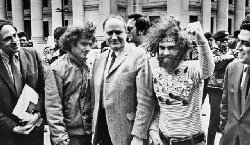
 I find the label “rabble-rouser” to be erroneous. First, it insults my readers and customers by describing them as “rabble”; second, a “rabble-rouser” is someone trying to stir the people for some political objective. It has connotations of the Yippies of the 1960’s, such as Jerry Rubin, Abbie Hoffman, and the rest of the Chicago Seven. No, my hair is far too short. The English have perhaps a more apt description, “Mixer,” meaning I am trying to engage people to think. My objective is to cause people to reconsider a position they may have overlooked or consider that which they commonly take for granted.
I believe this all started years ago at our company, a small management consulting firm with a special niche. Due to the competitive nature of the industry, it was essential all of the consultants operate in a consistent and predictable manner. Consequently, it was common for us to engage in debates about system design, project management, business systems planning, quality assurance, data base design, and much more. Such arguments led to the discovery of a four model approach to data base design (as opposed to three models). This discourse was invigorating as we were exercising mental gymnastics in search of what was logically correct. Our competitive edge was based on our search for the truth. If a customer wanted to know something, they turned to us first as they knew we had performed our homework.
I see myself more as the child who observed, “The Emperor has no clothes.” Over the years I have learned not to accept people at just face value. As such, I challenge the status quo to understand why something is done or if there cannot be a better way of improving the current mode of operation. However, challenging the status quo can present problems. People become too comfortable within it, and can react violently to any proposed change. As Machiavelli correctly observed in The Prince (1513)
It must be remembered that there is nothing more difficult to plan, more doubtful of success, nor more dangerous to manage than a new system. For the initiator has the enmity of all who would profit by the preservation of the old institution and merely lukewarm defenders in those who gain by the new ones.
Translation, defenders of the status quo tend to suffer from hardening of the arteries and react violently to new ideas.
My problem is that I ask people to think as opposed to operating on auto-pilot. If you have the audacity to think for yourself or ask questions, people can become indignant and will try to undermine your position, even if you haven’t arrived at a logical conclusion yet. Instead of realizing a person is in search for the truth, it is easier to accuse him of being a rabble-rouser thereby undermining his credibility.
I do not consider myself an intellectual, just an average Joe who has been around the block a few times and suffers from an acute case of common sense. My favorite branch of mathematics in school was Geometry which is nothing more than an exercise in logic. This puts me at a distinct advantage over others as I have learned common sense is not very common anymore. People will often say to me, “Just go with the flow.” The only problem with going with the flow is you are in all likelihood blindly headed towards a waterfall. I would rather do my own thinking as opposed to depending on others, and ultimately this is why I am perceived as a rabble-rouser for I have the nerve to ask, “Why?”
I also firmly believe our dependency on technology has stunted human thinking patterns and created social problems. My dream would be to knock out all forms of electronic communications thereby forcing people to snap out of their trance and begin to think for themselves again. Alas, it is but a pipe dream of mine.
My choice of words may seem unconventional, then again, I do not like to sugarcoat a problem or be politically correct. The petty taunts I receive and the innuendo my critics whisper like old ladies are amusing and I resist the temptation to respond in kind. Not to worry, I have developed some rather thick skin over the years. I am more concerned with seeking the truth as opposed to wallowing in the status quo.
Me, a rabble-rouser? I believe this says more about the accuser than the accused.
Keep the Faith!
Note: All trademarks both marked and unmarked belong to their respective companies.
Like the article? TELL A FRIEND.
Copyright © 2014 by Tim Bryce. All rights reserved.
NEXT UP: GREETING A STRANGER – Try it. You might even enjoy the reaction you receive.
LAST TIME: IMPROVING CUSTOMER SERVICE – Remember, good customer service is good business; Bad customer service is bad business.
Listen to Tim on WJTN-AM (News Talk 1240) “The Town Square” with host John Siggins (Mon, Wed, Fri, 12:30-3:00pm Eastern), KIT-AM 1280 in Yakima, Washington “The Morning News” with hosts Dave Ettl & Lance Tormey (weekdays. 6:00-9:00am Pacific), and KGAB-AM (650) of Cheyenne, Wyoming. Or tune-in to Tim’s channel on YouTube.