BRYCE ON MANAGEMENT
– What does a tie represent in the workplace?
(Click for AUDIO VERSION)
To use this segment in a Radio broadcast or Podcast, send TIM a request.
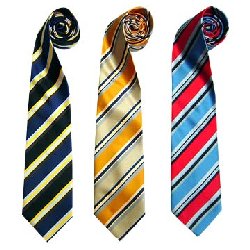 The Wall Street Journal recently ran an article on the decline of men wearing dress ties to work. They quoted a Gallup Poll that said the number of men who wear ties every day to work last year dropped to a record low of 6%. I’m not sure I agree with this number but there is no doubt ties have greatly diminished in the business world. I still put one on when I’m dealing with a customer and I do so as a sign of respect for the other party. Today it seems the only people who wear ties are politicians, newscasters, attorneys, doctors, and corporate executives, all of which do so as a sign of authority. And maybe they’re right.
Historically, learning to tie a tie marked a young man’s passage to manhood. But I don’t think there are a lot of men in the workforce who know how to tie a tie anymore, which I consider a little strange. Most newscasters know how to properly tie a tie, as do attorneys, but I’m starting to see politicians with sloppy looking ties. There are not too many things worse in a business setting than to be caught wearing a lousy clip-on.
In addition to how a tie is tied, I learned a long time ago the length of the tie and its relation to the belt buckle is important. In theory, long ties represent excessive behavior, and short ties infer personal inadequacies. Every once in awhile you see a bow tie or a western string tie, but I think they are worn more for a giggle than anything serious. The tie used to be the perfect present for holidays such as Father’s Day or Christmas, but most of the time we got a tie we wouldn’t be caught dead in. This resulted in closets full of ties we never threw away in fear we might offend someone. For example, I probably have a couple dozen ties in my closet, but I only have three that I regularly wear. I also have ties for special occasions, such as the Christmas holidays. I also have one representing my family’s Scottish Clan, but my favorite is one my father gave me years ago; It shows a series of small jackass’ sitting down with the following small letters underneath each one, “Y.C.D.B.S.O.Y.A.” Translation: “You Can’t Do Business Sitting On Your Ass.” It makes a great conversation piece.
As I said, I don’t know if I agree with the Gallup Poll’s 6% figure as I am starting to see people starting to wear ties again, particularly salesmen who use them to spruce up their image in front of customers. Frankly, they look much more professional than the typical corporate Polo shirt.
Now I know a lot of young men will read this and still be adamantly opposed to wearing ties but as I said earlier, it is a sign of respect. If this is of no interest to you, I’m sure you’ll continue to wear whatever you want, but for those of you who are interested in making a positive and professional impression, perhaps its time to go into the closet and pull out a couple of ties.
Keep the Faith!
Note: All trademarks both marked and unmarked belong to their respective companies.
 Tim Bryce is a writer and the Managing Director of M&JB Investment Company (M&JB) of Palm Harbor, Florida and has over 30 years of experience in the management consulting field. He can be reached at timb001@phmainstreet.com
For Tim’s columns, see:
timbryce.com
Like the article? TELL A FRIEND.
Copyright © 2013 by Tim Bryce. All rights reserved.
Listen to Tim on WJTN-AM (News Talk 1240) “The Town Square” with host John Siggins (Mon, Wed, Fri, 12:30-3:00pm Eastern), KGAB-AM 650 “The Morning Zone” with host Dave Chaffin (weekdays, 6:00-10:00am Mountain), and KIT-AM 1280 in Yakima, Washington “The Morning News with Dave and Lance” with hosts Lance Tormey & Mike Bastinelli (weekdays. 6:00-9:00am Pacific). Or tune-in to Tim’s channel on YouTube.