BRYCE ON LIFE
– An art that is difficult to master.
(Click for AUDIO VERSION)
To use this segment in a Radio broadcast or Podcast, send TIM a request.
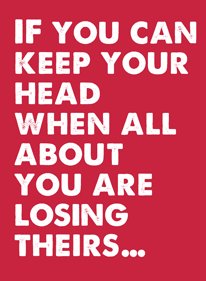 Ever since college, I have been an admirer of Rudyard Kipling’s classic poem, “If,” whereby he writes:
“If you can keep your head when all about you
Are losing theirs and blaming it on you,
If you can trust yourself when all men doubt you,
But make allowance for their doubting too;
If you can wait and not be tired by waiting,
Or being lied about, don’t deal in lies,
Or being hated, don’t give way to hating,
And yet don’t look too good, nor talk too wise:”
The lesson here is in order to lead a mature and positive life, we should actively try to practice patience and understanding. Further, life is short and the best way to socialize and get ahead in this crazy world is to simply keep your wits about you. This isn’t quite as easy as it seems, particularly in the 21st century where road rage is common, office rage, marriage rage, etc. As I’ve mentioned in the past, I blame a lot of our problems of impatience and intolerance on the excessive use of technology where our expectations are programmed to do everything instantaneously, and we resent any form of delay, be it a speed limit, waiting in line, or arguing with another, particularly regarding politics. Patience seems to be in short supply these days.
Patience means biding your time; to wait for the proper moment or opportunity. This may be rather agonistic particularly as we seem to be spending an eternity waiting in lines for something. The right moment may never occur. Further, our patience is tried by the multitudes of people trying to invade our space mostly for purposes of advertising. For example, consider the pop-up windows suddenly appearing on our desktop, the uninvited video clips constantly harassing us, the voluminous spam e-mails we receive, and how audio volume is increased on television or radio whenever a commercial comes on. It’s like screaming kids clinging on to a mother’s dress.
Impatience is caused by many different situations:
* When our focus is broken by an irritating distraction.
* When plans and expectations are not realized thereby causing frustration.
* You cannot seem to connect with another person in conversation (they do not understand you).
* You are stymied by technology, either inexplicably working too slow or considered “unfriendly” to use.
* When your progress is unfathomably impeded by others, particularly among motorists texting or talking on their smart phones.
* Someone rants on and on about something trivial or nonsensical, aka “gobbledygook” or “BS”.
* Or you are just inconvenienced and feel slighted, such as waiting in line.
Simple frustration is the prime cause of losing our patience. Knowing this, customer service representatives should be more sensitive to our frustrations, but they seldom are and go on autopilot instead, thereby compounding the problem. It takes an empathetic person to be sensitive to the frustrations of others.
If you have got all the time in the world, you can afford to be patient, such as retirees. However, if you are still working and trying to get things done, regardless of their importance, you are more likely to be aware of the clock and not want to waste your time. However, where is our time going? To technology. I would suggest a national “Turn Off the Technology” Day, but it is so imbued in our society, a lot of people would spazz out and suffer withdrawal.
We all have our breaking points. Some fuses are longer than others. I would like to believe my fuse is longer than most, but I have my moments, such as trying to digest the BS of “political correctness,” watching an injustice go unchallenged, or driving behind someone who obviously believes he/she is the only person on the highway. I sometimes find it necessary to simply walk away from something as opposed to compounding the problem, or in some instances, pull off the roadway until the problem has dissipated. This is probably why I prefer driving early in the morning or late at night in order to avoid such problems.
Some people find it necessary to step back from a problem and take a deep breath before continuing, thereby refreshing one’s focus. Since technology is often the culprit for becoming impatient, simply turning it off works wonders, be it a radio or television, a smart phone, a computer, or whatever device you are plugged into, thereby eliminating irritating distractions. Just turn it off, clear your head, and refocus. It’s that simple.
It’s also important to find time during the day for ourselves. We do a lot for others during the work day, such as customers, employees, vendors, or our boss and family. Our inclination is to assist or serve others, which can easily add to stress. To overcome this, find some private time during the day for you to collect your thoughts; nothing radical, just something simple, such as reading a book, closing your eyes for a cat nap, taking a walk, or just stopping to smell the roses. Such respites break up the monotony of the day, allows you to collect your thoughts, and brings your stress level down.
Practicing patience is an important part of our ability to socialize with others. Quite often, we believe it is someone else causing our frustration, and maybe that’s true. However, we must also admit we create our own problems by being self-centered and not practicing a little courtesy to others. Just remember, if you can maintain your focus, if you can remain calm in the midst of catastrophe, and do unto others as you would have others do unto you…
“Yours is the Earth and everything that’s in it,
And—which is more—you’ll be a Man, my son!”
– Rudyard Kipling
Keep the Faith!
Note: All trademarks both marked and unmarked belong to their respective companies.
 Tim Bryce is a writer and the Managing Director of M&JB Investment Company (M&JB) of Palm Harbor, Florida and has over 30 years of experience in the management consulting field. He can be reached at timb001@phmainstreet.com
For Tim’s columns, see:
timbryce.com
Like the article? TELL A FRIEND.
Copyright © 2013 by Tim Bryce. All rights reserved.
Listen to Tim on WJTN-AM (News Talk 1240) “The Town Square” with host John Siggins (Mon, Wed, Fri, 12:30-3:00pm Eastern), KGAB-AM 650 “The Morning Zone” with host Dave Chaffin (weekdays, 6:00-10:00am Mountain), and KIT-AM 1280 in Yakima, Washington “The Morning News” with hosts Lance Tormey & Brian Teegarden (weekdays. 6:00-9:00am Pacific). Or tune-in to Tim’s channel on YouTube.